Showing posts with label repertoire. Show all posts

Saturday, January 12, 2019

DANCE | INDIAN DANCE CLASSICAL DANCE | MOHINIYATTAM

MOHINIYATTAM

Mohiniyattam, also spelled Mohiniattam, is one of the eight classical dances of India that developed and remain popular in the state of Kerala. The other classical dance form from Kerala is KathakaliMohiniyattam dance gets its name from the word Mohini – a mythical enchantress avatar of the Hindu god Vishnu, who helps the good prevail over evil by deploying her feminine powers.
 Mohiniyattam's roots, like all classical Indian dances, are in the Natya Shastra – the ancient Hindu Sanskrit text on performance arts. However, it follows the Lasya style described in Natya Shastra, that is a dance which is delicate, eros-filled and feminine. It is traditionally a solo dance performed by women after extensive training. The repertoire of Mohiniyattam includes music in the Carnatic style, singing and acting a play through the dance, where the recitation may be either by a separate vocalist or the dancer herself. The song is typically in Malayalam-Sanskrit hybrid called Manipravalam.

HISTORY

The earliest mention of the word is found in the 16th-century legal text Vyavaharamala, but the likely roots of the dance are older. The dance was systematized in the 18th century, was ridiculed as a Devadasi prostitution system during the colonial British Raj, banned by a series of laws from 1931 through 1938, a ban that was protested and partially repealed in 1940. The socio-political conflict ultimately led to renewed interest, revival and reconstruction of Mohiniyattam by the people of Kerala, particularly the poet Vallathol Narayana Menon.

REPERTOIRE
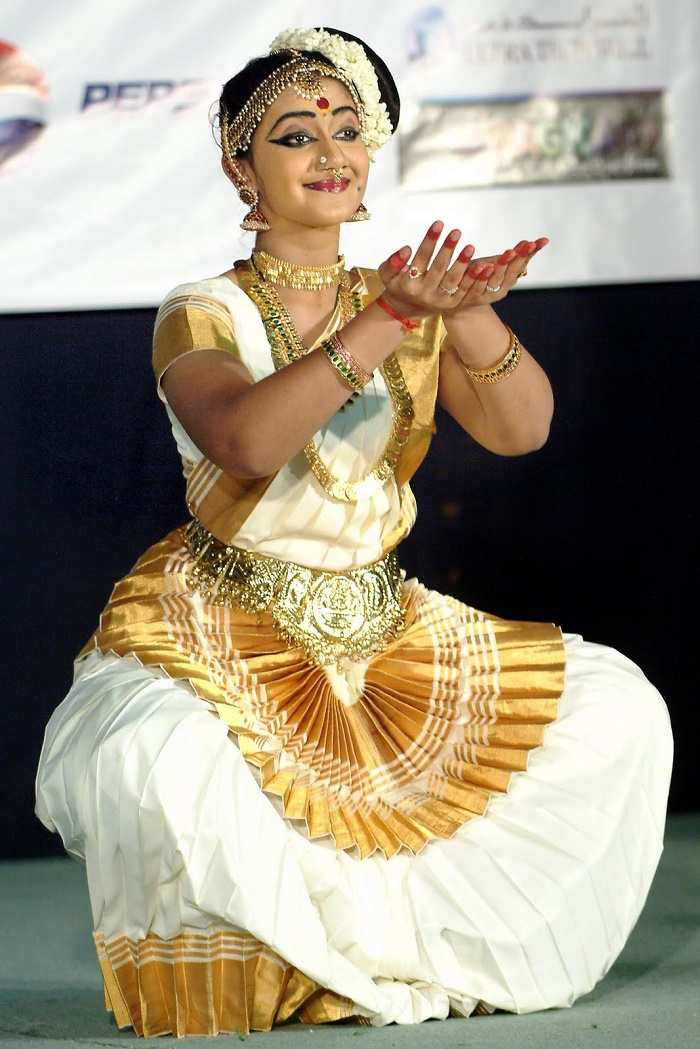
Image result for mohiniyattam repertoire
Mohiniyattam is a lasya subgenre of dance, performed in the Kaisiki vritti (graceful style), as discussed in ancient Indian performance arts texts such as the Natya Shastra. More specifically, it is a dance that excels in Ekaharya Abhinaya form, that is a solo expressive dance performance aided by singing and music. The dance includes nritta (pure dance, solo), nritya (expressive dance, solo) and modern productions sometimes include natya(play, group dance):
  • The Nritta performance is abstract, rhythmic aspect of the dance that appears early and at the end of the dance repertoire. The viewer is presented with pure movement, wherein the emphasis is the beauty in motion, form, speed, range and pattern. This part of the repertoire has no interpretative aspect, no telling of story.

  • The Nritya is the expressive aspect of the dance that attempts to communicate a storyline, with emotions and feelings, with spiritual themes. In a nritya, the dance-acting (Abhinaya, Vaittari) expands to include silent expression of words through hand and facial gestures and body motion set to musical notes. The dancer articulates a legend or a spiritual message, aiming to engage the emotions and mind of the viewer.

The basic posture of Mohiniyattam is parted feet, knees bent outwards, an erect upper torso, gentle 8-shape side to side swaying of body along with hips (Ati Bhanga). The footwork is soft, sliding and synchronous with the musical beat and acting. The body movement is sometimes described in terms of calming images of nature as the swinging of the palm leaves, and the gentle undulating of ocean waves.
The basic dance units in Mohiniattam are known as atavus or atavukal, and these are grouped into four: Taganam, Jaganam, Dhaganam and Sammisram. The hand and facial gestures of the dance follow the classical text of Hastha Lakshanadeepika, which has elaborate description of mudras.

SEQUENCE

Image result for mohiniyattam SEQUENCE

The repertoire sequence of Mohiniyattam is similar to that of Bharatanatyam, and contains seven items that are performed to a structure described in classical dance texts: Cholkettu (invocation, but starts with offering reverence to a goddess Bhagavati and ends with a prayer to Shiva), Jatisvaram or more precisely Swarajeti, Varnam (a play wherein she embeds a mimicry for distraction while communicating the underlying story or message), Padam (song), Tillana (dancer's interpretation of melody the musician create), Shlokam and Saptam.

COSTUMES

Image result for mohiniyattam costume images

The costume includes plain white or off-white such as ivory or cream colored sari embroidered with bright golden or gold laced colored brocade (similar to a ceremonial Kasavu saree). She wears a fitted choli (blouse) matching the sari, below which at the waist is a golden belt which tucks in the end of the sari, and highlights the waist. In front of the saree, below the belt is pleated sheet with concentric bands in gold or saffron colors, which allow freedom of movement and assist in visually communicating the mudra to distant audience.
The dancer wears relatively simple jewelry and no masks, in contrast to the other major classical dance of Kerala called Kathakali. Her jewelry typically includes items on fingers, wrists, neck and ears (which may have bells). The face makeup is natural, but lips are brilliant red, she has the Hindu tikka (Gobi) on her forehead and her eyes are lined to help prominently highlight the eye movements during the dance. Her ankles are adorned with leather straps with bells (chilanka), feet and fingers colored red with natural dyes. Her hairdo is gathered and tied into a smooth tight round chignon on one side of her head (typically left) and the bun then ringed with fragrant flowers (typically jasmine mulla).

Wednesday, January 9, 2019

DANE | INDIAN DANCE | CLASSICAL DANCE | MANIPURI

MANIPURI


Manipuri dance, also known as Jagoi, is one of the major Indian classical dance forms, named after the region of its origin – Manipur, a state in northeastern India bordering with Myanmar (Burma), AssamNagaland and Mizoram. It is particularly known for its Hindu Vaishnavism themes, and exquisite performances of love-inspired dance drama of Radha-Krishna called Raslila. However, the dance is also performed to themes related to ShaivismShaktism and regional deities such as Umang Lai during Lai Haraoba. 

The Manipuri dance is a team performance, with its own unique costumes, aesthetics, conventions and repertoire. The Manipuri dance drama is, for most part, marked by a performance that is graceful, fluid, sinuous with greater emphasis on hand and upper body gestures. 

Manipuri dance is a religious art and its aim is the expression of spiritual values. Aspects of this performance art is celebrated during Hindu festivals and major rites of passage such as weddings among the Manipuri people, particularly in the ethnic majority of Meitei people. The dance drama choreography shares the plays and stories of 'Vaishnavite Padavalis', that also inspired the major Gaudiya Vaishnava-related performance arts found in Assam and West Bengal.

HISTORY

The roots of Manipuri dance, as with all classical Indian dances, is the ancient Hindu Sanskrit text Natya Shastra, with influences and the culture fusion between various local folk dance forms. According to the traditional legend, the indigenous people of the Manipur valley were the dance-experts revered as Gandharvas in the Hindu epics (Ramayana and Mahabharata), suggesting a dance tradition has existed in Manipur since antiquity. With evidence of Vishnu temples in the medieval era, the dance arts have been passed down verbally from generation to generation as an oral tradition. The first reliably dated written texts describing the art of Manipuri dance are from the early 18th-century.

REPERTOIRE

Image result for manipuri dance history

The traditional Manipuri dance style embodies delicate, lyrical and graceful movements. The dance features rounded soft sensuous movements of women, and occasional fast movements by male characters. Unlike other classical Indian dances with religious themes, the Manipuri dance artists do not wear anklet bells and the footwork is subdued and gentle in the Manipuri style. The stage movements is part of a composite movement of the whole body.

Chali or Chari is the basic dance movement in Manipuri Ras dances. The repertoire and underlying play depends on the season. The dances are celebrated on full moon nights, three times in autumn (August through November) and once again in spring (March or April). The Vasant Ras is timed with the Hindu festival of colors called Holi, while others are timed with post-harvest festivals of Diwali and others. The plays and songs recited during the dance performance center around the love and frolics between Radha and Krishna, in the presence of Gopis named Lalita, Vishakha, Chitra, Champaklata, Tungavidya, Indurekha, Rangadevi and Sudevi. There is a composition and dance sequence for each Gopi, and the words have two layers of meanings, one literal and other spiritual. The longest piece of the play focuses on Radha and Krishna. The dancer playing Krishna expresses emotions, while the body language and hand gestures of the Gopi display their feelings such as longing, dejection or cheer.


COSTUMES

Image result for manipuri dance

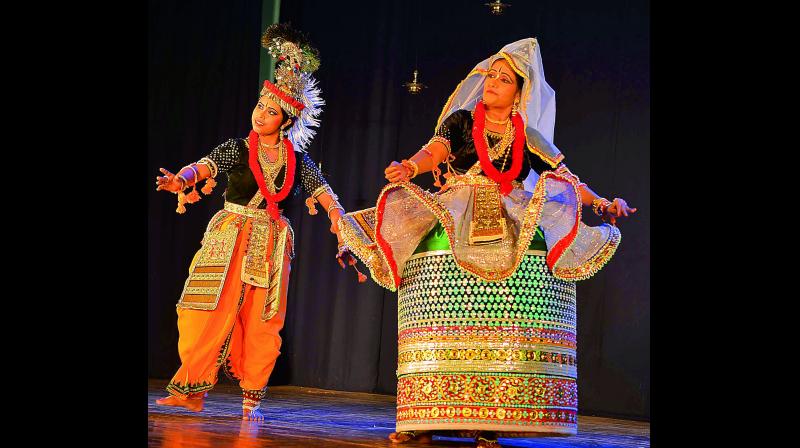
The classical Manipuri dance features unique costumes. The women characters are dressed like a Manipuri bride, in Potloi costumes, of which the most notable is the Kumil. A Kumil is an elaborately decorated barrel shaped long skirt stiffened at the bottom and close to the top. The decorations on the barrel include gold and silver embroidery, small pieces of mirrors, and border prints of lotus, Kwaklei orchid, and other items in nature. The Kumil may be an adaptation of Fanek (or Phanek) – a tighter sarong-like wear which is used in more vigorous dances and by male characters. The Kumil is bordered at the top with undulating gauzy translucent top skirt shaped like an open flower, and tied in Trikasta or three places around the waist (front, back and one side) with spiritual symbolism of the ancient Hindu texts. The upper body is dressed in a velvet blouse, the head covered in a white translucent veil, to symbolically mark elusiveness. The dancers do not wear bells on ankles as in other classical Indian dances, but like them Manipuri dance artists do adorn the face, neck, waist, hands and legs with round jewelry ornaments or flower garlands that flow with the dress symmetry. The symmetrical translucent dress, states Reginald Massey, makes "the dancers appear to float on the stage, as if from another world".
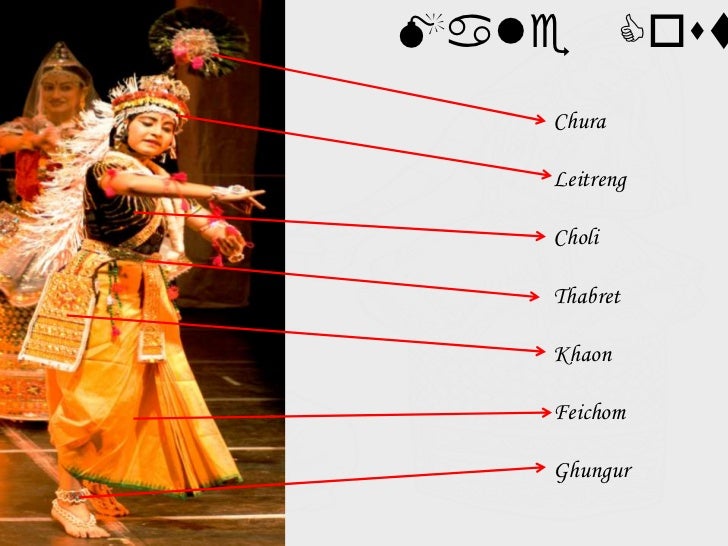
The male characters dress in a dhoti (also called dhotra or dhora) – a brilliantly colored broadcloth pleated, wrapped and tied at waist and allowing complete freedom of movement for the legs. The Krishna character wears a peacock feather containing crown, with a feathery attachment at the back.
Image result for manipuri dance history