ODISSI
Odissi is learnt and performed as a composite of basic dance motif called the Bhangas (symmetric body bends, stance). It involves lower (footwork), mid (torso) and upper (hand and head) as three sources of perfecting expression and audience engagement with geometric symmetry and rhythmic musical resonance. An Odissi performance repertoire includes invocation, nritta (pure dance), nritya (expressive dance), natya (dance drama) and moksha (dance climax connoting freedom of the soul and spiritual release).
Traditional Odissi exists in two major styles, the first perfected by women and focussed on solemn, spiritual temple dance (maharis); the second perfected by boys dressed as girls (gotipuas) which diversified to include athletic and acrobatic moves, and were performed from festive occasions in temples to general folksy entertainment. Modern Odissi productions by Indian artists have presented a diverse range of experimental ideas, culture fusion, themes and plays.
Basic moves and mudras

Odissi mudra murals in Bhubaneswar
The basic unit of Odissi are called bhangas. These are made up of eight belis, or body positions and movements, combined in many varieties. Motion is uthas (rising or up), baithas (sitting or down) or sthankas (standing). The gaits or movement on the dance floor is called chaalis, with movement tempo linked to emotions according to the classical Sanskrit texts. Thus, for example, burhas or quick pace suggest excitement, while a slow confused pace suggests dejection. For aesthetics, movement is centered on a core, a point in space or floor, and each dancer has her imaginary square of space, with spins and expression held within it. The foot movement or pada bhedastoo have basic dance units, and Odissi has six of these, in contrast to four found in most classical Indian dances.
The three primary dance positions in Odissi are:
- Samabhanga – the square position, with weight equally placed on the two legs, spine straight, arms raised up with elbows bent.
- Abhanga – the body weight shifts from side to side, due to deep leg bends, while the feet and knees are turned outwards, and one hip extending sideways.
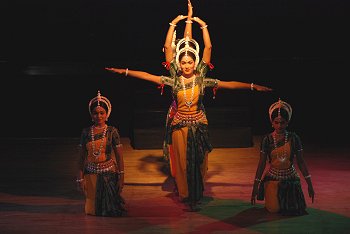
- Tribhanga – is an S-shaped three-fold bending of body, with torso deflecting in one direction while the head and hips deflecting in the opposite direction of torso. Further, the hands and legs frame the body into a composite of two squares (rectangle), providing an aesthetic frame of reference. This is described in the ancient Sanskrit texts, and forms of it are found in other Hindu dance arts, but tribhangapostures developed most in and are distinctive to Odissi, and they are found in historic Hindu temple reliefs.
Mudras or Hastas are hand gestures which are used to express the meaning of a given act. Like all classical dances of India, the aim of Odissi is in part to convey emotions, mood and inner feelings in the story by appropriate hand and facial gestures. There are 63 Hastas in modern Odissi dance, and these have the same names or structure as those in the pan-Indian Hindu texts, but most closely matching those in the Abhinaya Chandrika. These are subdivided into three, according to the traditional texts:
- Asamyukta Hasta – Single hand Mudras – 28 Prakar (gestures, for instance to communicate a salute, prayer, embrace, energy, bond, swing, carriage, shell, arrow, holding a thing, wheel, and so on.)
- Samyukta Hasta – Double hand Mudras – 24 Prakar (gestures, for instance to indicate a flag, flower, type of bird or animal, moon, action like grasping, and so on.)
- Nrutya Hasta – “Pure Dance” Mudras
The Mudra system is derived from the "Abhinaya Darpana" by Nandikeshavara and the ancient Natya Shastra of Bharata Muni.
Costumes
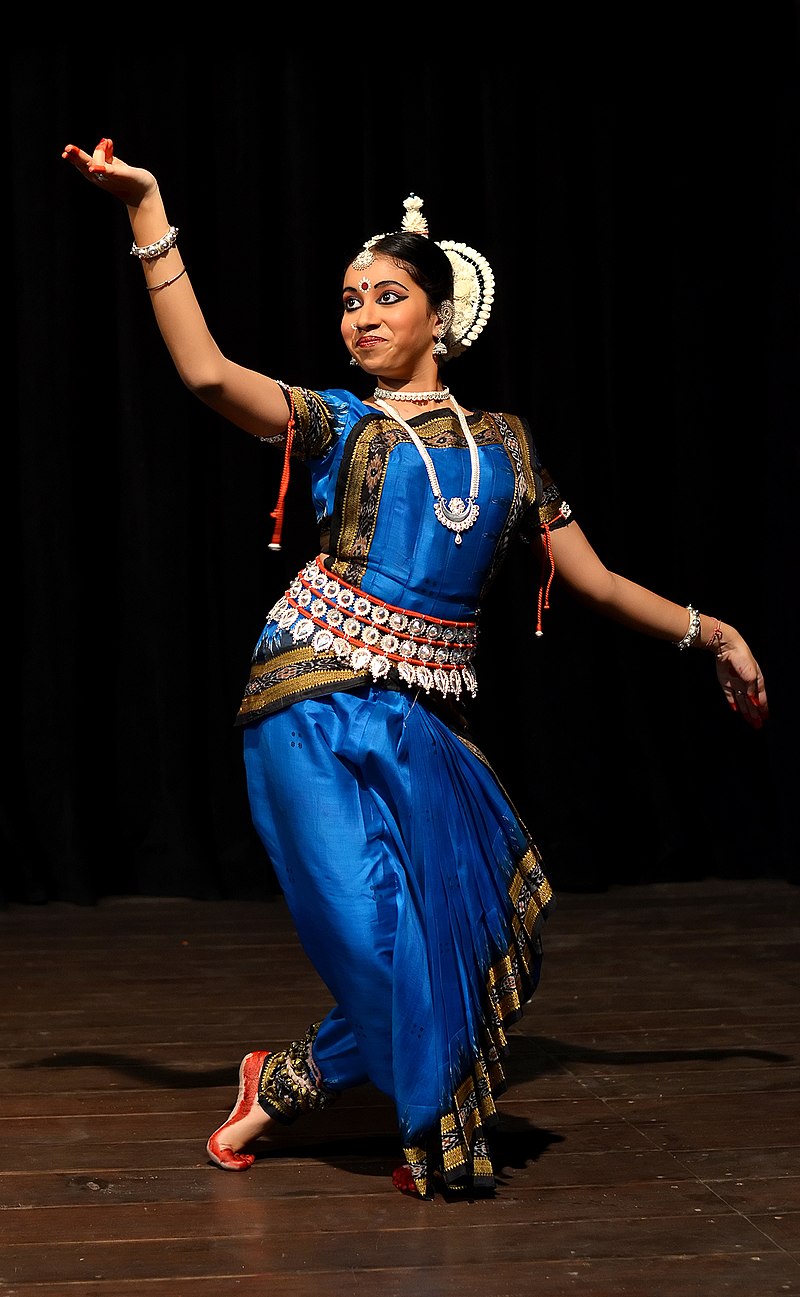
The Odissi dancers are colorfully dressed with makeup and jewellery. The Saree worn by Odissi dancers are brightly coloured, and usually of local silk (Pattasari). It is worn with pleats, or may have a pleat tailor stitched in front, to allow maximum flexibility during the footwork.These sarees have traditional prints of Odisha with regional designs and embellishments, and may be the Sambalpuri Saree and Bomkai Saree.
The jewellery includes silver pieces, a metal favored in regional tradition. The hair is tied up, and typically drawn into an elaborate bun resembling a Hindu temple spire, and decorated with Seenthi. Their hairstyle may contain a moon shaped crest of white flowers, or a reed crown called Mukoot with peacock feathers (symbolism for Lord Krishna). The dancers forehead is marked with Tikka, and adorned with various jewelry such as the Allaka (head piece on which the tikka hangs). The eyes are ringed with Kajal (black eyeliner).
Ear covers called Kapa or ear rings decorate the sides of the head, while necklace adorns the neck. The dancer wears a pair of armlets also called Bahichudi or Bajuband, on the upper arm. The wrist is covered with Kankana (bangles). At the waist they wear an elaborate belt which ties down one end of the Sari. The ankles are decorated with a leather piece on top of which are bells (ghungroo). The dancer's palms and soles may be painted with red coloured dye called the Alta.
Modern Odissi male performers wear dhoti – a broadcloth tied around waist, pleated for movement, and tucked between legs; usually extends to knee or lower. Upper body is bare chested, and a long thin folded translucent sheet wrapping over one shoulder and usually tucked below a wide belt.