Showing posts with label dance. Show all posts

Monday, February 25, 2019

DANCE | INDIAN DANCE | SEMI-CLASSICAL DANCE | OYILATTAM

OYILATTAM


Image result for OYILATTAM DANCE 


Oyilattam ( meaning: dance of grace) is a folk dance with origins in the Madurai region of Tamil Nadu. The dance has its origins in southern Tamil Nadu and is primarily performed in Madurai district, Tirunelveli district and Tiruchirapalli district. It was traditionally a dance where a few men would stand in a row with two kerchiefs perform rhythmic steps to the musical accompaniment, with the number of dancers increasing; over the past ten years women have also started performing this dance. Typically, the musical accompaniment is the Thavil and the performers have coloured handkerchiefs tied to their fingers and wear ankle bells. Oyilattam is one of the folk arts identified for mainstreaming by the Tamil university. Mainly Oyilattam is performed at village festivals. It is basically describing the great epics like ramayana, mahabaratha and also lord muruga's history.
 

Monday, January 21, 2019

DANCE | INDIAN DANCE | SEMI-CLASSICAL DANCE | CHHAU

CHHAU


Image result for chau mask
Chhau dance, also spelled as Chau or Chhaau, is a semi classical Indian dance with martial, tribal and folk traditions, with origins in the eastern Indian state Odisha. It is found in three styles named after the location where they are performed, i.e. the Purulia Chau of Bengal, the Seraikella Chau of Jharkhand, and the Mayurbhanj Chau of Odisha.
The dance ranges from celebrating martial artsacrobatics and athletics performed in festive themes of a folk dance, to a structured dance with religious themes found in ShaivismShaktism and Vaishnavism. The costumes vary between the styles, with Purulia and Serakeilla using masks to identify the character. The stories enacted by Chhau dancers include those from the Hindu epics the Ramayana and the Mahabharata, the Puranas and other Indian literature.
The dance is traditionally an all males troupe, regionally celebrated particularly during spring every year, and may be a syncretic dance form that emerged from a fusion of classical Hindu dances and the traditions of ancient regional tribes. The dance is amazing and brings together people from diverse socio-economic backgrounds in a festive and religious spirit.

Three styles of Chhau

Ileana Citaristi performing Mayurbhanj Chhau (Shaivism theme).
The Seraikella Chhau developed in Seraikela, the present day administrative headquarters of the Seraikela Kharsawan district of Jharkhand, the Purulia Chhau in Purulia district of West Bengal and the Mayurbhanj Chhau in Mayurbhanj district of Odisha. The most prominent difference among the three subgenres is regarding the use of masks. While, the Seraikela and Purulia subgenres of Chhau use masks during the dance, the Mayurbhanj Chhau uses none.
The Seraikella Chhau's technique and repertoire were developed by the erstwhile nobility of this region who were both its performers and choreographers, and in the modern era people from all backgrounds dance it. The Seraikella Chhau is performed with symbolic masks, and the acting establishes the role the actor is playing. The Purulia Chhau uses extensive masks shaped in the form of the character being played; for example, a lion character has a face mask of lion and body costumes too with the actor walking on all fours. These masks are crafted by potters who make clay images of Hindu gods and goddesses and is primarily sourced from the Purulia district of West Bengal. In the Mayurbhanj Chhau is performed without masks and is technically similar to the Seraikella Chhau.

Chhau mask

Image result for chau mask
The most interesting fact, Purulia Chhau Dance is listed on UNESCO’s world heritage list of dances. The main difference between the Purulia chhau and Odisha chhau is in the use of the mask. Purulia chhau used the mask in dance, but Odisha does not have the mask thereby adding facial expression with body movement and gesture. Traditionally, the chhau dance held in the mid march when one agricultural circle end and a new circle begins. Purulia chhau dancer were the earthy and theatrical mask which represent the mythological characters. After making the shape of mask with clay, it is coloured and decorated with Shola and other things.
The Chhau mask of Purulia is registered under Geographical Indications. As the basic difference of Purulia Chhau the mask is unique and traditional.
These chhau masks are made by the artists from the Sutradhar community. The making of a mask goes through various stages. 8-10 layers of soft paper, immersed in diluted glue, are pasted one after another on the mould before the mud mould is dusted with fine ash powder. The facial features are made of clay. A special layer of mud and cloth is applied and the mask is then sun-dried. After this, the mould is polished and the second round of sun drying is done before separating the layers of cloth and paper from the mould. After finishing and drilling of holes for the nose and eyes, the mask is colored and decorated.

Wednesday, January 16, 2019

DANCE | INDIAN | SEMI CLASSICAL

SEMI-CLASSICAL DANCE


The steps and moves of semi-classical dances are not as complex or intricate as pure classical forms. However, the authenticity of the Indian dance form is preserved and students are able to grasp these lighter semi-classical dances easily. Semi-classical dances are fun and fluid.
This type of dance breaks the stylized structures and forms of the classical dance, and adopts a more contemporary feel and steps. All along the ethos of the basic dance remains intact. Semi classical is the combination of classical dance performed on any Bhajans and Ghazals.
Image result for semi classical dance meaning

Monday, December 31, 2018

DANCE | INDIAN DANCE | CLASSICAL DANCE | KUCHIPUDI


KUCHIPUDI


Kuchipudi  is one of the eleven major Indian classical dances. It originated in a village named Kuchipudi in the Indian state of Andhra Pradesh.
Kuchipudi is a dance-drama performance, with its roots in the ancient Hindu Sanskrit text of Natya Shastra. It developed as a religious art linked to traveling bards, temples and spiritual beliefs, like all major classical dances of India. Evidence of Kuchipudi's existence in an older version are found in copper inscriptions of the 10th century, and by the 15th century in texts such as the Machupalli KaifatKuchipudi tradition holds that Tirtha Narayana Yati – a sanyassin of Advaita Vedanta persuasion, and his disciple, an orphan named Siddhendra Yogi, founded and systematized the modern version of Kuchipudi in the 17th century. Kuchipudi largely developed as a Hindu god Krishna-oriented Vai shnavism tradition, and it is most closely related to Bhagavata Mela performance art found in Tamil Nadu.
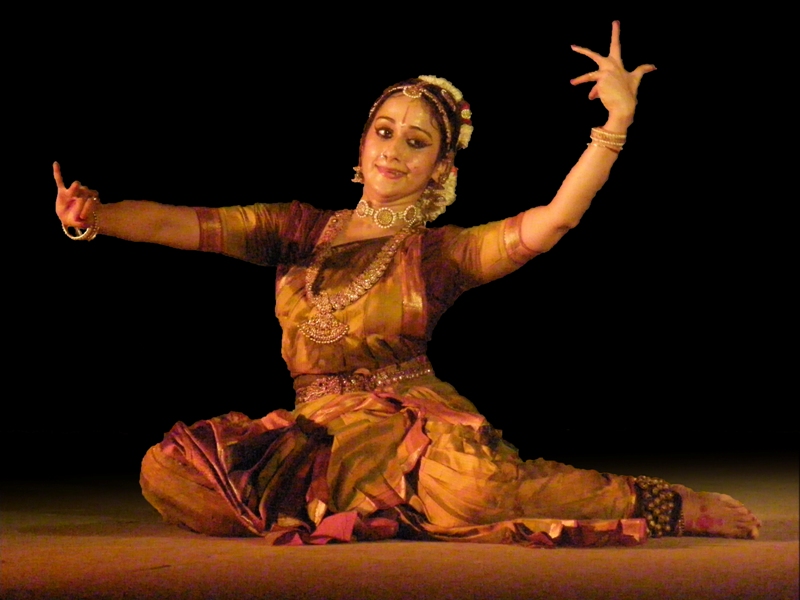


The Kuchipudi performance usually begins with an invocation. Then, each costumed actor is introduced, their role stated, and they then perform a short preliminary dance set to music (dharavu). Next, the performance presents pure dance (nritta). This is followed with by the expressive part of the performance (nritya), where rhythmic hand gestures help convey the story. Vocal and instrumental Carnatic music in the Telugu language accompanies the performance. The typical musical instruments in Kuchipudi are mridangamcymbalsveenaflute and the tambura.
The popularity of Kuchipudi has grown within India, and it is performed worldwide.

Costumes

The traditional Kuchipudi was performed by all males troupe. A dancer in a male role would be in Angivastra, also known as Bagalbandi, wear a dhoti (a single pleated piece of cloth hanging down from the waist).A dancer in a female role would wear a Sari with light makeup.
Modern productions retain the male dress, but are more elaborate and Bharatanatyam-like for the female roles. Women artists wear a brilliantly colorful Sari (or a body fitting dress) with a pleated fan stitched in front to help highlight the exacting footwork. The end of the wrapped Sari is held fast under a light metallic (golden or brass) belt at waist. A Kuchipudi artist braids her hair somewhat differently than a Bharatanatyam artist, to reflect the regional traditions, yet wearing flowers are common. Both have symbolic elements embedded in their hair and face jewelry, such as the Vedic symbolisms for the sun and the moon, the soul and the nature, and she sometimes sets her hairdo in the tribhuvana style which represents the three worlds. Her jewelry may include hair jewelry, ear, nose, armlets, necklaces and often a leather anklet piece with little bells (ghungroo). The forehead has a round red bindi or a symmetric tillaka, while the eyes are typically ringed with black collyrium to ease the viewing of expressions by the audience.


Some special Kuchipudi plays may include unusual costumes and theatrics, such as round bottom water pot balanced on the head, dancing with gymnastics or stilt athletics. Other plays may include wing props, a transparent head sheet, or peacock feathered crown to identify the actor playing Krishna.

Repertoire

The repertoire of Kuchipudi, like all major classical Indian dance forms, follows the three categories of performance in the ancient Hindu text Natya Shastra. These are Nritta, Nritya and Natya.
  • The Nritta performance is abstract, fast and rhythmic aspect of the dance. The viewer is presented with pure movement in Nritta, wherein the emphasis is the beauty in motion, form, speed, range and pattern. This part of the repertoire has no interpretative aspect, no telling of story. It is a technical performance, and aims to engage the senses (prakriti) of the audience.
  • The Nritya is slower and expressive aspect of the dance that attempts to communicate feelings, storyline particularly with spiritual themes in Hindu dance traditions. In a nritya, the dance-acting expands to include silent expression of words through gestures and body motion set to musical notes. The Kuchipudi actor articulates a story (particularly of Krishna) or a spiritual message. This part of a repertoire is more than sensory enjoyment, it aims to engage the emotions and mind of the viewer.
  • The Natyam is a play, typically a team performance, but can be acted out by a solo performer where the dancer uses certain standardized body movements to indicate a new character in the underlying story. A Natya incorporates the elements of a Nritya. Kuchipudi, in its history relied on a team a dance-actors, while in modern times Kuchipudi productions include solo or duo performances.

Saturday, December 29, 2018

Dance | Indian dance | Classical dance | Kathak


KATHAK


Kathak (कथक) is the Hindi name for one of the eight major forms of Indian classical dance. The origin of Kathak is traditionally attributed to the traveling bards of ancient northern India known as Kathakars or storytellers. The term Kathak is derived from the Vedic Sanskrit word Katha which means "story", and Kathaka which means "the one who tells a story", or "to do with stories". Wandering Kathakars communicated stories from the great epics and ancient mythology through dance, songs and music in a manner similar to early Greek theatre. Kathak dancers tell various stories through their hand movements and footwork, but most importantly through their facial expressions. Kathak evolved during the Bhakti movement, particularly by incorporating the childhood and stories of the Hindu god Krishna, as well as independently in the courts of north Indian kingdoms.


Kathak is found in three distinct forms, called "gharanas", named after the cities where the Kathak dance tradition evolved – JaipurBanaras and Lucknow. While the Jaipur gharana focuses more on the foot movements, the Banaras and Lucknow gharanas focus more on facial expressions and graceful hand movements. Stylistically, the Kathak dance form emphasizes rhythmic foot movements, adorned with small bells (Ghungroo), and the movement harmonized to the music. The legs and torso are generally straight, and the story is told through a developed vocabulary based on the gestures of arms and upper body movement, facial expressions, stage movements, bends and turns. The main focus of the dance becomes the eyes and the foot movements. The eyes work as a medium of communication of the story the dancer is trying to communicate. With the eyebrows the dancer gives various facial expressions. The difference between the sub-traditions is the relative emphasis between acting versus footwork, with Lucknow style emphasizing acting and Jaipur style famed for its spectacular footwork.
Kathak Duet Performance
Kathak Group Performance
kathak rounds
Kathak Facial Expressions

Thursday, December 27, 2018

INDIAN CLASSICAL DANCE

Indian classical dance, or Shastriya Nritya, is an umbrella term for various performance arts rooted in religious Hindu musical theatrestyles, whose theory and practice can be traced to the Sanskrit text Natya Shastra.
The number of recognized classical dances range from eight to more, depending on the source and scholar. The Sangeet Natak Akademi recognizes eight – BharatanatyamKathakKuchipudiOdissiKathakaliSattriyaManipuri and Mohiniyattam. Scholars such as Drid Williams add ChhauYakshagana and Bhagavata Mela to the list. The Culture Ministry of the Government of India includes Chhau in its classical list. These dances are traditionally regional, all of them include music and recitation in local language or Sanskrit, and they represent a unity of core ideas in a diversity of styles, costumes and expression. Indian classical dance is made from India and classical dance is played by various actors.

Dance forms

The Natya Shastra mentions four Pravrittis (traditions, genres) of ancient dance-drama in vogue when it was composed – Avanti (Ujjain, central), Dakshinatya (south), Panchali(north, west) and Odra-Magadhi (Odisha-Bihar-Bengal, east).
Sources differ in their list of Indian classical dance forms. Encyclopædia Britannica mentions six dances. The Sangeet Natak Akademi has given recognition to nine Indian dances.The Indian government's Ministry of Culture includes eleven dance forms.[34] Scholars such as Drid Williams and others include ChhauYaksagana and Bhagavata Melato the eight classical Indian dances in the Sangeet Natak Akademi list.
The classical dance forms recognised by the Sangeet Natak Akademi and the Ministry of Culture are: